France is the perfect destination for a short escape from the UK. Within a couple of hours by train or plane, you can be sipping coffee on a Parisian terrace, wandering through the traboules of Lyon or watching the sun set over the Mediterranean in Nice. Each French city has its own personality, its own flavours and its own rhythm, which makes choosing your next weekend away both exciting and delightfully difficult.
Paris: Beyond the Postcard
Paris is the obvious first choice, and for good reason: no other city in Europe is so easy to reach from London, with the Eurostar delivering you to Gare du Nord in little more than two hours. On a first visit, the Eiffel Tower, the Louvre and Notre-Dame, reopened after its long restoration, deserve their place on the list. Yet the Parisians themselves will tell you that the real city lies elsewhere.
It lies in the neighbourhoods, each of which feels like a village. The Marais hides Renaissance mansions and quiet courtyards behind its busy shopping streets. Montmartre still has vineyards, steep staircases and artists’ studios above the tourist crowds of the Place du Tertre. The Canal Saint-Martin, lined with iron footbridges and chestnut trees, is where young Parisians gather for a picnic on warm evenings.
The secret of a successful Paris weekend is to resist the temptation to see everything. Choose one major museum a day, book it online to skip the queues, and leave the afternoons free for walking. Some of the city’s greatest pleasures cost nothing at all: a bench in the Luxembourg Gardens, the view from the steps of the Sacré-Cœur at sunset, or a stroll along the Seine as the lights come on over the bridges.
Lyon and Lille: Two Cities Made for a Long Weekend
These two cities are often overlooked by British visitors, yet both offer an ideal balance of culture, food and manageable size.
Lyon, the Gourmet’s Choice
Lyon has a claim to being the capital of French gastronomy, and it takes that title seriously. Its traditional bouchons serve quenelles, saucisson brioché and praline tart in cosy, noisy dining rooms, while the covered market of Les Halles Paul Bocuse is a temple to cheese, charcuterie and oysters. Between meals, the UNESCO-listed old town reveals its traboules, hidden passageways that cut through buildings from one street to the next, and the funicular climbs to Fourvière for a sweeping view over the meeting of the Rhône and Saône.
Lille, the Easy Escape
Just over an hour and a half from London by Eurostar, Lille feels different from the rest of France, with a Flemish accent in its architecture and its food. The Grand Place is framed by ornate gabled façades, and the courtyard of the Vieille Bourse hosts second-hand booksellers and chess players. Art lovers should not miss the Palais des Beaux-Arts or La Piscine, a museum set in a former Art Deco swimming pool in nearby Roubaix.
Bordeaux: Stone, River and Wine
Twenty years ago, Bordeaux was a grey, sleepy port. Today it is one of the most elegant cities in France, its eighteenth-century façades cleaned to a honey-coloured glow and its quays along the Garonne transformed into a long promenade for walkers, cyclists and skaters.
The heart of the city is the Place de la Bourse, reflected in the Miroir d’Eau, a vast shallow pool that alternates between a thin film of water and a cloud of mist. Children run through it, photographers wait for the perfect reflection at dusk, and it has become the symbol of the new Bordeaux. From there, the pedestrian streets of the old town lead to lively squares full of wine bars and restaurants.
Wine, of course, is never far away. The Cité du Vin, a striking building on the banks of the river, explores wine cultures from around the world and ends with a tasting at the top of its tower. For many visitors, this is the start of a longer love story, and deciding between Bordeaux, Burgundy or the Rhône Valley becomes the next pleasant dilemma. The medieval village of Saint-Émilion, less than an hour away, makes an easy first step into the vineyards.
Nice and Marseille: City Breaks in the Sunshine
When the British winter feels endless, the Mediterranean is only two hours away by plane, and its two great cities offer very different experiences.
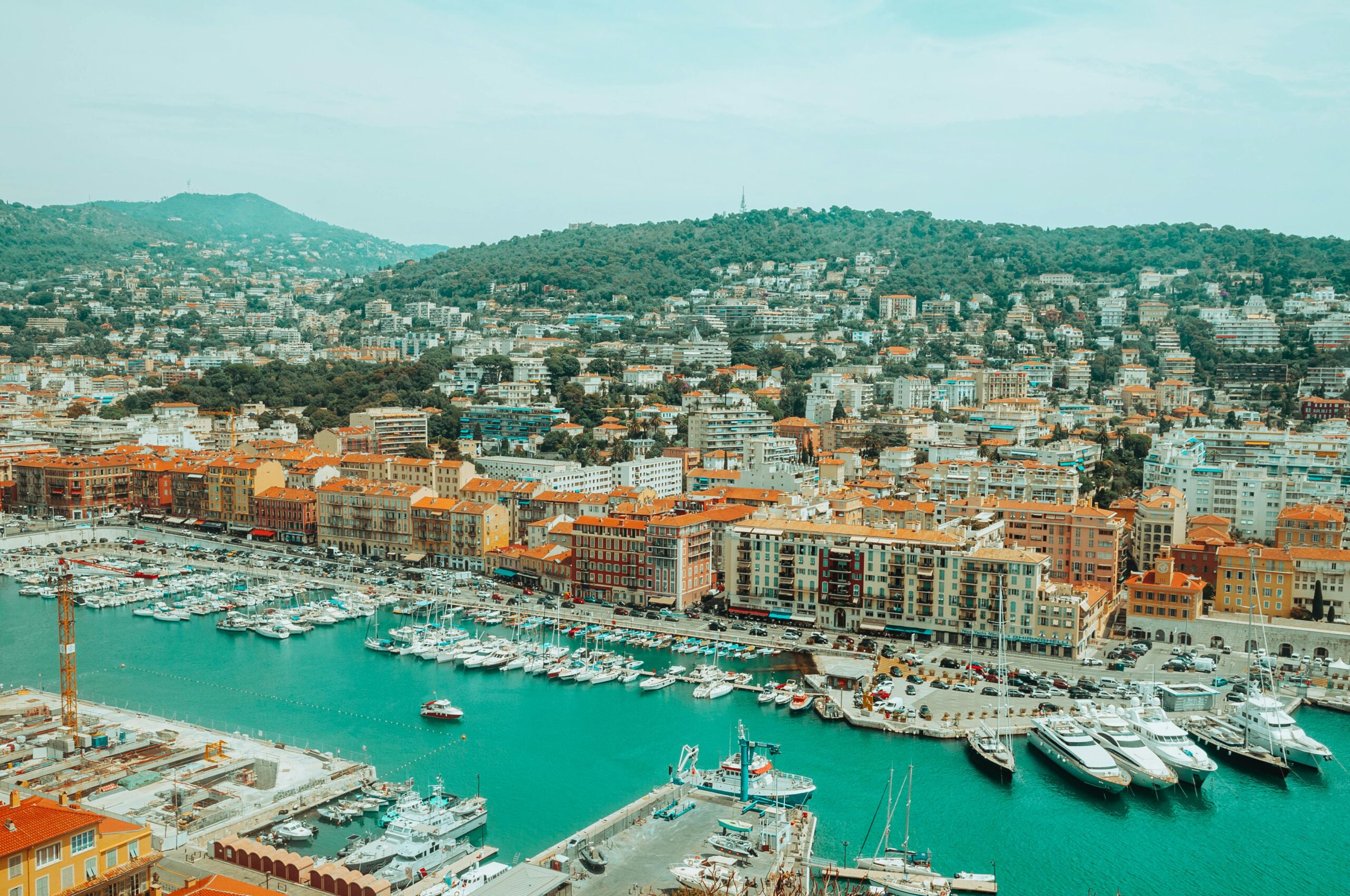
Nice is elegant and relaxed. The Promenade des Anglais, named after the English aristocrats who wintered here in the nineteenth century, stretches for seven kilometres along the Baie des Anges. Behind it, the old town is a maze of ochre and pink façades, where the Cours Saleya market sells flowers, fruit and socca, the chickpea pancake that locals eat hot from the griddle. Thanks to an efficient coastal railway, Nice is also the perfect base for day trips to Villefranche-sur-Mer, Èze, Monaco or Antibes, without ever needing a car.
Marseille is louder, bolder and more surprising. France’s oldest city revolves around its Vieux-Port, where fishermen still sell their morning catch, while the Panier district climbs the hill in a tangle of narrow streets, street art and artisan workshops. The Mucem museum links the old fort of Saint-Jean to the modern waterfront by a spectacular footbridge. And just beyond the city limits, the Calanques National Park reveals turquoise coves between white limestone cliffs, a natural gateway to the best places to visit in Provence.
Strasbourg: The Winter Favourite
Some cities are at their best in summer; Strasbourg comes into its own in December. Its Christmas market, held since the sixteenth century, is one of the oldest in Europe, and the whole city turns into a vast illuminated decoration, with stalls selling mulled wine, bredele biscuits and gingerbread around the cathedral.
The rest of the year, Strasbourg’s charm lies in its unique blend of French and German influences. The district of La Petite France, with its half-timbered houses, flower-decked balconies and canals, looks like a scene from a fairy tale, and a boat trip along the Ill is the best way to discover it. The Gothic cathedral, with its astronomical clock and its single spire, dominates the old town, while the European Parliament gives the city an international atmosphere.
Strasbourg is also the gateway to the Alsace Wine Route, whose villages, such as Riquewihr and Colmar, are within easy reach by train or car. Reaching the city from London is simple too: fly to Strasbourg or Basel, or take the Eurostar to Paris and continue by TGV in under two hours.
Making Three Days Feel Like a Week
A city break is short by definition, and a few simple habits can make the difference between a rushed weekend and a relaxed one. French cities are compact, walkable and well connected, which rewards a slower approach.
- Book trains early: Eurostar and TGV fares rise as departure approaches, and the cheapest seats often sell out weeks ahead for spring and December weekends
- Reserve the big museums online: the Louvre, the Musée d’Orsay and the Cité du Vin all operate timed tickets, and walk-up queues can swallow half a morning
- Use city passes: Paris, Lyon, Bordeaux and Nice sell passes that combine public transport with museum entries, often paying for themselves in two days
- Leave the car at home: metros and trams are fast and cheap, while parking in city centres is scarce and expensive
- Think about Sundays and Mondays: many shops close on Sunday, and several national museums close on Monday or Tuesday
Above all, keep one evening free of plans. Choosing a restaurant on a whim, following the sound of music into a square or lingering over a last glass on a terrace is often what visitors remember most.
From the grand boulevards of Paris to the sunny quays of Marseille, France offers a city break for every taste. Whether you are drawn by art, gastronomy, history or simply the pleasure of a café terrace in the sun, you will always find a reason to come back.
So pack a light bag, book your train or flight, and let a French city surprise you. Bon week-end !